.png?w=1920&q=75)

When people talk about mobile apps, they usually think about design, features, or how good the interface looks. But the real magic sits quietly in the background—the backend that keeps everything running smoothly. And here’s the interesting part: the better the backend, the better the entire app feels to the user, even if they never see it.
Think about the apps you use every day. The way your messages are sent instantly, your orders update in real time, and your notifications appear within seconds—none of this happens by accident. It needs a backend that’s quick on its feet, stable under pressure, and flexible enough to grow with time.
This is exactly where Node.js shines. It’s not a trend or a buzzword; it’s a practical tool that makes backend development feel lighter, faster, and far less complicated. Developers like it because it keeps things simple. Businesses prefer it because it supports growth. And users benefit from the speed and smoothness it brings to everyday interactions.
Whether you’re partnering with a Backend Development Company, planning a new mobile app, or upgrading an existing one, understanding why Node.js is such a powerful option can help you make smarter decisions.
Understanding the Mobile App Backend
When you open a mobile app, everything you see on the screen—buttons, menus, images, colours—is the frontend. But everything the app does in the background is handled by the backend. You may not notice it, but it controls almost every important action. The backend is like the part of a restaurant you never see: the kitchen. You only see the food served on your table, but all the real work happens behind the doors.
In the same way, a mobile app’s backend quietly powers the features users depend on every day. For example, the backend is responsible for:
- Loading data quickly whenever you open the app
- Logging you into your account and keeping your information safe
- Processing payments without errors
- Sending notifications and alerts at the right time
- Updating status or information in real time, like tracking a delivery
- Saving and retrieving your data, whether it’s past orders or chat history
Even though users never see the backend, they immediately feel when something is wrong—slow screens, login issues, failed payments, or late notifications are all signs of a weak or poorly built backend.
That’s why choosing the right backend technology is so important. As an app becomes popular, more people start using it at the same time. The backend must be strong enough to grow with the app, handle more traffic, and stay stable without breaking. If the backend can’t scale, the entire app struggles no matter how good it looks.
This is where Node.js becomes such a reliable choice. It supports the kind of performance, speed, and flexibility that modern apps need, especially when they grow quickly. The backend stays smooth, responsive, and capable of handling heavy user activity—exactly what today’s apps require.
Now that you have a clear picture of what a mobile app backend actually does and why it matters so much, the next question is simple: what makes Node.js such a good fit for all this behind-the-scenes work? Many technologies can build a backend, but only a few can manage speed, real-time interactions, sudden user growth, and smooth performance all at once. Node.js stands out because it handles these everyday challenges in a practical, efficient way—not just in theory, but in real-world apps that people use daily. Let’s look at the core reasons why Node.js fits mobile app backends so perfectly.
The Core Reasons Node.js Fits Mobile App Backends Perfectly
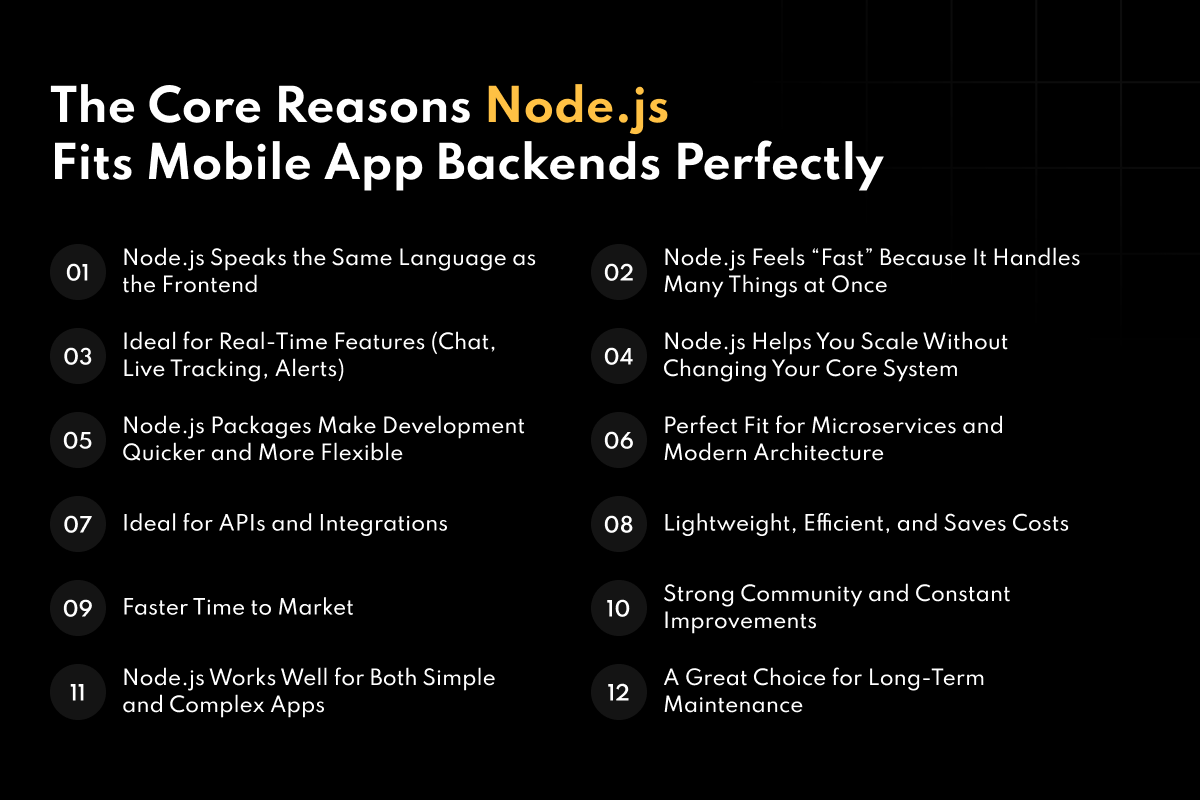
1. Node.js Speaks the Same Language as the Frontend
Most mobile apps involve two major layers:
- The app screen that users interact with
- The backend that stores data, handles logic, and communicates with servers
Node.js uses JavaScript—the same language used for frontend development. This creates a huge advantage: One language across the entire project. Developers don’t have to switch their thinking between different languages for frontend and backend. This leads to:
- Faster development
- Fewer mistakes
- Easier onboarding
- Smoother collaboration
This is one reason companies trust Node.js development services to deliver apps quickly without compromising quality. It simply removes unnecessary friction.
2. Node.js Feels “Fast” Because It Handles Many Things at Once
Most mobile apps today need to handle multiple tasks at the same time—notifications, location updates, payments, chats, user actions, and more. Node.js is great at multitasking without slowing down. It runs on a non-blocking model, which in simple words means:
It doesn’t wait for one task to finish before starting another. This makes Node.js suitable for apps like:
- Messaging apps
- Live tracking
- Social feeds
- Booking apps
- Gaming apps
- On-demand service apps
If your business hires a Backend Development Company with experience in Node.js, they can build apps that respond quickly, even under heavy traffic.
3. Ideal for Real-Time Features (Chat, Live Tracking, Alerts)
Many mobile apps today rely on instant reactions:
- Delivery status updates
- Live chat with support
- Friend-to-friend messaging
- Food order movement
- Driver locations
- Real-time finance updates
- Notifications that sync across devices
Node.js is practically built for these situations. It keeps the connection open and active, allowing quick communication between the server and the app. This is also why many businesses rely on a Node.js development company when building apps that need live features—because not all backend technologies handle real-time tasks well, but Node.js does.
4. Node.js Helps You Scale Without Changing Your Core System
Every business hopes its app grows.
- More users.
- More downloads.
- More transactions.
But growth also means more server pressure. Here’s the good news: Node.js can scale without needing a total backend rebuild. It grows gradually and easily, which saves a lot of time and money. Some reasons it scales well:
- Lightweight architecture
- Ability to split the app into microservices
- Efficient resource usage
- Easy handling of thousands of simultaneous users
This is why experienced teams offering backend development services often prioritize Node.js for apps expected to grow fast.
5. Node.js Packages Make Development Quicker and More Flexible
The Node.js community has created thousands of ready-made packages through NPM (Node Package Manager). These packages help developers build features faster.
For example:
- File upload handling
- Authentication
- Payment gateways
- Email sending
- Security enhancements
- API integrations
- Image processing
Instead of building everything from scratch, developers can plug in tested, reliable tools.
When a business hires Node.js development services, they benefit from this large ecosystem, getting faster delivery and more stable solutions.
6. Perfect Fit for Microservices and Modern Architecture
Older backend systems often come as one big block of code. If one part breaks, the whole system suffers. Updates are slow, risky, and expensive. Node.js supports a more modern approach called microservices, where your app is split into smaller, manageable components.
Why does this help?
- Each part can be updated separately
- Teams can work in parallel
- Errors stay limited to one area
- New features can be added without touching old ones
A skilled Backend Development Company often chooses Node.js when clients want long-term flexibility and hassle-free updates.
7. Ideal for APIs and Integrations
Most mobile apps need to connect with:
- Payment services
- Social login (Google, Facebook, Apple)
- Maps
- Email/SMS platforms
- CRMs or ERPs
- Third-party tools
Node.js is naturally suited for building fast and secure APIs. It handles large amounts of requests with ease and connects well with almost any modern tool. This is one of the reasons businesses prefer working with a Node.js development company—integrations become smoother and less error-prone.
8. Lightweight, Efficient, and Saves Costs
Node.js is efficient with server resources.
This means:
- You need fewer servers
- You pay less for hosting
- Your app performs better even with limited infrastructure
For startups and mid-size companies, this cost advantage can be huge. Even established enterprises choose Node.js to optimize backend performance without spending heavily on servers. Teams providing Node.js development services often highlight this benefit because it has direct financial impact.
9. Faster Time to Market
In the mobile app world, speed matters. Being early often means staying ahead of competitors.
Node.js helps teams launch faster because:
- One language is used everywhere
- Many ready-made packages exist
- The architecture is lightweight
- Developers can build features in parallel
This is why choosing a skilled Backend Development Company familiar with Node.js can significantly shorten your launch time.
10. Strong Community and Constant Improvements
Node.js is not a fading trend. It has a huge global community of developers, companies, and contributors. What does that mean for your mobile app?
- You get long-term support
- Security updates are frequent
- New tools and libraries keep improving the ecosystem
- Developers find solutions faster
- No fear of the technology becoming outdated
When you use Node.js, you’re using something trusted by thousands of global teams.
11. Node.js Works Well for Both Simple and Complex Apps
Some backend technologies work great only for small apps. Some work great only for enterprise apps. Node.js can handle both. Whether your app is:
- A simple booking platform
- A growing e-commerce app
- A large-scale social app
- A real-time on-demand service
- A user-generated content platform
- A finance or wallet-based system
Node.js can support it smoothly. This flexibility is a big reason businesses prefer hiring a specialized Node.js development company that can tailor the system based on project complexity.
12. A Great Choice for Long-Term Maintenance
Once your mobile app goes live, the real work begins:
- Updates
- New features
- Bug fixes
- Performance improvements
- Security enhancements
Node.js makes maintenance easier because the codebase is clean, modern, and more understandable for developers. When paired with expert backend development service, your app stays stable and future-ready for years.
Real-World Apps Using Node.js for Mobile Backends
Some of the world’s biggest mobile apps use Node.js—and their reasons are very practical. Companies like Netflix, Uber, PayPal, and LinkedIn depend on Node.js because it handles speed, scale, and real-time activity extremely well. These brands also work with expert teams similar to a professional Backend Development Company because their apps must run smoothly even under massive traffic.
Here’s why these companies chose Node.js:
- Netflix uses Node.js to improve speed and reduce app loading time.
- Uber depends on Node.js for real-time driver and rider updates.
- PayPal shifted to Node.js so both frontend and backend teams could use one language, making development faster.
- LinkedIn moved its mobile backend to Node.js for better performance and lighter server usage.
These examples show why many businesses rely on a trusted Node.js development company and prefer Node.js development services—the technology stays fast, flexible, and reliable even when millions of users are active at the same time.
When Node.js Is NOT the Right Choice
While Node.js works beautifully for most mobile app backends, it’s fair to say that it’s not perfect for every situation. And being clear about its limitations helps businesses make better decisions.
Node.js is not the best option for CPU-heavy tasks—for example, apps that need to process large files, handle heavy video editing, or run complex background calculations. These tasks can slow down the event loop, which affects overall performance.
It’s also not ideal for intense AI or machine-learning operations. Tasks like training big models or running deep data analysis usually need more powerful, specialized technologies designed for heavy computation.
Similarly, apps that constantly run resource-heavy background work may struggle if Node.js is the only choice. In such cases, developers often combine Node.js with other technologies to balance performance.
A professional Backend Development Company or an experienced Node.js development company will usually guide businesses honestly. They may recommend mixing Node.js with other tools—or choosing something else entirely—if it benefits long-term performance.
This honest evaluation builds trust and ensures that businesses choose the right backend, not just the trendy one.
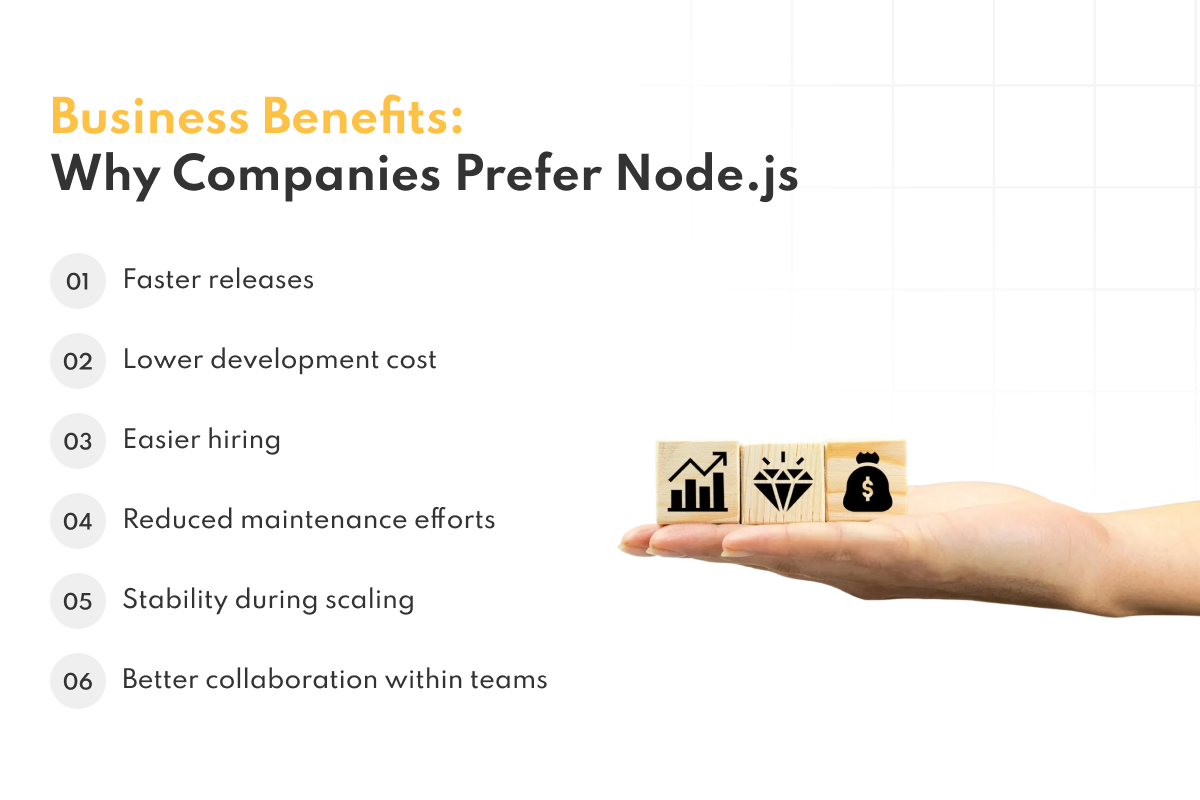
Business Benefits: Why Companies Prefer Node.js
From a business point of view, Node.js offers practical advantages that directly affect timelines, budgets, and long-term growth. This is why many companies choose it when working with a trusted Node.js development company. Here’s what makes it so appealing:
- Faster releases
Because developers use the same language on both frontend and backend, the workflow becomes smooth and quick. Teams can launch features and updates much faster. - Lower development cost
With less complexity and fewer technologies to manage, businesses save time and budget. Node.js reduces the learning curve and avoids unnecessary overhead. - Easier hiring
JavaScript developers are widely available. This makes it simpler and more affordable for companies to build or expand their team. - Reduced maintenance efforts
Node.js supports clean, modular code. This makes future updates, fixes, and improvements easier—helping businesses save money in the long run. - Stability during scaling
As user numbers increase, Node.js handles the growth smoothly without needing a total system rebuild. This makes scaling predictable and cost-effective. - Better collaboration within teams
With one unified language, designers, frontend developers, and backend developers communicate more efficiently.
These business-friendly advantages are why many modern companies prefer Node.js development services to build stable, scalable, and future-ready mobile app backends.
Final Thoughts
Node.js is not “perfect” because it is trendy. It is perfect for mobile app backend development because it solves real-world problems in a simple, practical way:
- Speed
- Scalability
- Real-time capability
- Flexibility
- Lower cost
- Faster development
- Easier maintenance
When teams partner with the right Backend Development Company, they get the best out of Node.js. And when supported by skilled Node.js development services, mobile apps become smoother, faster, and ready for future growth. Node.js continues to be one of the strongest backend choices—not because of hype, but because it quietly delivers what modern mobile apps truly need.