.png?w=1920&q=75)

The backend is the part of your app or website you don’t see — but it’s what keeps everything working as it should. You don’t always see it, but it’s doing all the heavy lifting — handling databases, servers, and the logic that makes everything run smoothly. Without a strong backend, even the best-looking app can struggle to perform well.
The demand for solid backend solutions is booming, and with more businesses going digital, that growth isn’t slowing down anytime soon. In this fast-moving space, the companies that truly stand out are the ones that mix strong technical skills with clear communication and a well-tested process.
But what exactly makes one company better than another in this space—especially in 2025, when technology, user demands, and security expectations are at an all-time high?
Understanding Backend Development in 2025
When we talk about backend development, we’re talking about everything that happens behind the scenes of an app or website. It includes setting up servers, managing databases, writing APIs, and creating the logic that powers features like user logins, data storage, or online payments.
In simple words, backend developers make sure your app works smoothly when someone clicks a button or submits a form. They write the code that handles data, connects different parts of the system, and keeps everything running in the background.
Popular languages and tools used by backend developers today include Node.js, Python, Java, PHP, Ruby on Rails, Django, Spring Boot, and Laravel, among others. A good Backend Development Company will choose the right tech stack based on your project’s needs — not just what’s trending.
Now, in 2025, backend development has evolved a lot. One big change is the shift from large, single systems to smaller, flexible ones called microservices. Instead of building one big app, developers break it into small parts that can work independently. This makes it easier to update, scale, and manage.
It’s estimated that more than 70% of applications will use microservices architecture by the end of 2025. That’s because it allows different teams to work on separate components and make quick improvements without touching the whole system.
Another trend is the rise of serverless computing and edge computing. These modern approaches help reduce server costs and make apps faster by processing data closer to the user. A smart Backend Development Company will help you adopt these technologies to make your systems more efficient and cost-effective.
We’re also seeing a lot more AI integration in backend systems. AI tools are now being used to automate tasks like bug fixing, testing, and even writing parts of the code. In fact, most developers in the U.S. now use AI tools in their daily work.
At the same time, businesses are handling more data than ever before. To stay competitive, companies need real-time data insights and personalized features powered by machine learning. That’s why leading backend teams build strong data pipelines and systems that can process both structured and unstructured data smoothly.
And of course, security and reliability remain crucial. With systems becoming more complex and spread out, security can't be an afterthought. Good backend companies follow DevSecOps practices — which means they build security into every stage of development. They also set up proper logging, monitoring, and alert systems to spot and fix problems early.
In short, by 2025, a great Backend Development Company is one that not only understands the latest tech trends but also builds systems that are secure, scalable, and ready for the future.
Key Traits of a Standout Backend Development Company in 2025
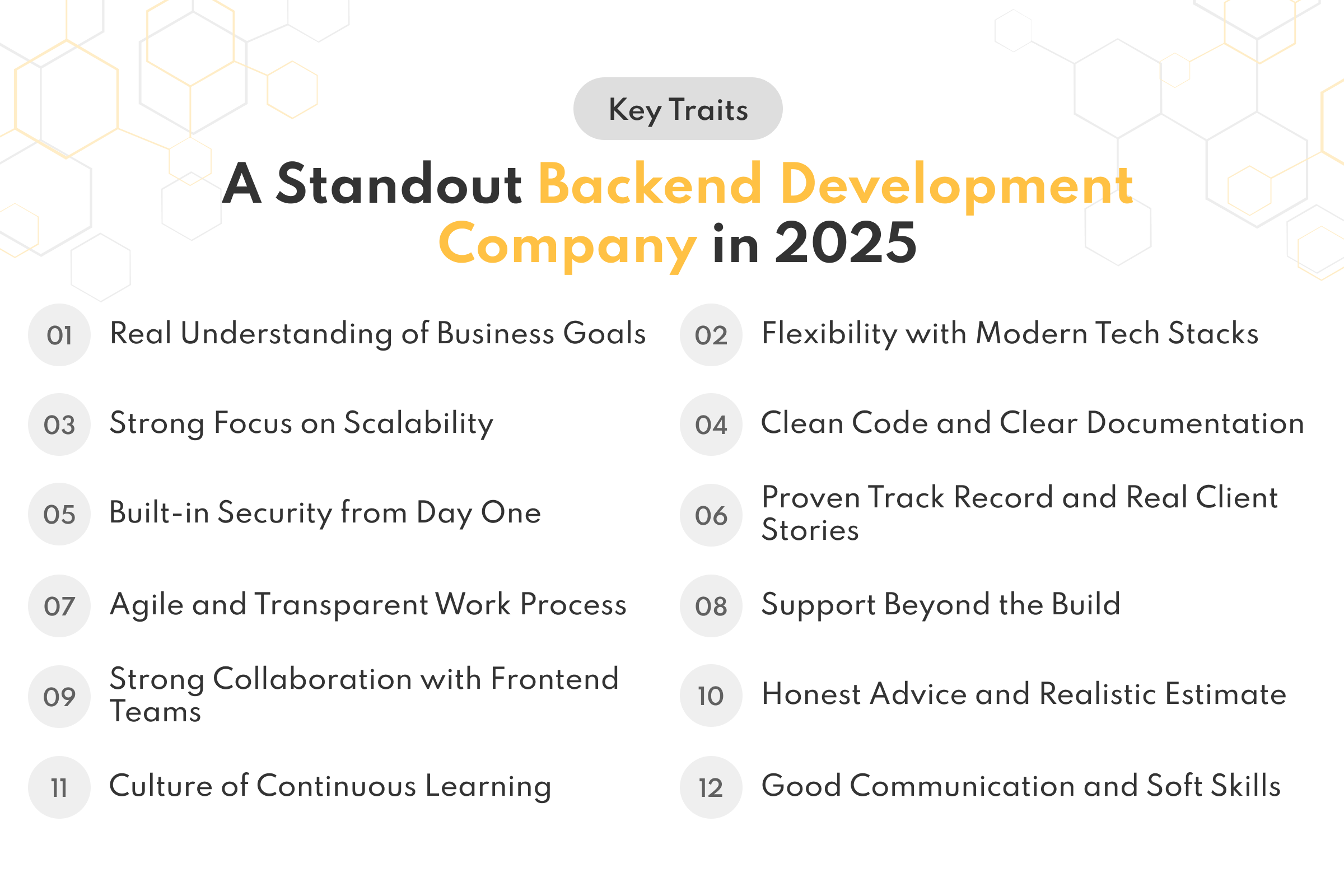
1. Real Understanding of Business Goals
A good backend development service provider doesn’t just write code. It understands what you’re building and why. Whether you're a startup founder launching a new product or an enterprise CTO scaling infrastructure, you need a partner who asks the right questions:
- What problem is this app solving?
- Who are the users?
- How fast does it need to scale?
- What kind of data will it handle?
When a backend team starts from understanding your business—rather than just the tech—they build something that works better, lasts longer, and needs fewer patches.
2. Flexibility with Modern Tech Stacks
The backend world today is packed with tools: Node.js, Python, Java, .NET, Ruby, Go, and cloud platforms like AWS, Azure, and Google Cloud. But here’s the thing—having knowledge isn’t enough.
The best backend development companies are flexible. They don’t push just one tech stack on every client. Instead, they recommend what's best based on your project’s needs, your budget, and your team’s ability to manage it later on.
They stay updated, but they also stay practical.
3. Strong Focus on Scalability
Products can grow overnight. One tweet, one product launch, or one good review—and suddenly, thousands of users are hitting your app. That’s why scalability isn’t an afterthought anymore.
A standout backend development team designs systems with growth in mind. They use smart architecture, microservices where needed, caching systems, and load balancing strategies so that your product can handle traffic surges without crashing.
It’s not just about “can it run?” but also “can it keep running when you need it most?”
4. Clean Code and Clear Documentation
Backend code may not be visible, but messy code causes delays, bugs, and frustration. Great companies take pride in writing code that’s clean, maintainable, and well-organized.
Even more important—they document everything. Why? So that your internal developers, future hires, or even other agencies can pick up where they left off without scratching their heads.
If you ever decide to switch vendors or expand your dev team, good documentation will save you time, money, and a lot of stress.
5. Built-in Security from Day One
With data breaches and privacy regulations becoming tighter, security can't be something you “add later.” Backend developers need to build security into the core.
This means:
- Strong authentication systems
- Encrypted data storage
- Secure APIsRegular code audits
- Compliance with GDPR, HIPAA, or other legal standards depending on your region
You should only hire backend developers who treat security as a non-negotiable part of the job.
6. Proven Track Record and Real Client Stories
Anyone can build a flashy website and list popular tech stacks. But what separates an average backend development team from a great one is proof.
They’ll have:
- Case studies that show how their backend work solved real problems
- Testimonials from happy clients
- References they’re proud to share
Ask for their past work, especially projects similar to yours. A company that has solved problems for others in your industry is more likely to get your project right.
7. Agile and Transparent Work Process
One of the most frustrating things in development is when you feel left in the dark. No updates, unclear timelines, unexpected delays.
Standout backend companies keep things transparent. They use agile methods—breaking work into sprints, giving you regular updates, showing you progress demos, and adjusting as needed.
You’ll always know what’s happening and when. That level of communication makes a huge difference, especially when you’re working across time zones.
8. Support Beyond the Build
Launching a backend is just the start. Bugs pop up, users find edge cases, traffic patterns shift. You need support that continues after the build is done.
Great backend development companies offer:
- Post-launch monitoring
- Maintenance packages
- Quick bug fixes
- Performance tuning
- Help with scaling and upgrades
They don’t leave you stranded once the main job is over—they become long-term tech partners.
9. Strong Collaboration with Frontend Teams
Backend doesn’t live in a vacuum. It powers everything the frontend team is trying to build—from login flows to dashboards to payment systems.
When speed and cross-team communication are critical, you want a backend development company that works with your frontend developers—not against them.
They should speak the same language, understand UI needs, and help create seamless user experiences.
10. Honest Advice and Realistic Estimates
The best backend companies don’t overpromise just to win the deal.
They’ll tell you what’s possible, what will take time, and what can wait for later. They’ll help you phase your project realistically—starting with a solid MVP and scaling up from there.
This kind of honesty saves your budget and builds trust from the very beginning.
11. Culture of Continuous Learning
Tech doesn’t stand still, and neither do the top backend teams.
In 2025, standout companies are the ones that:
- Encourage internal learning
- Keep up with emerging frameworks
- Experiment with better tools
- Attend tech events and contribute to open source
When you hire backend developers from such a team, you’re getting more than skill—you’re getting fresh thinking.
12. Good Communication and Soft Skills
Yes, technical skills matter. But when deadlines are tight and priorities shift, communication becomes just as important.
Great backend developers:
- Listen to your concerns
- Explain things in a way you understand
- Set clear expectations
- Stay calm under pressure
When you’re choosing a backend development company, make sure you actually enjoy talking to them. That’s a sign they’ll be easy to work with when things get complex.
Questions to Ask Before Choosing a Backend Development Company
Before you sign any contract, vet your potential backend partner thoroughly. Here are some essential questions (and why they matter):
What technologies and industries do you specialize in? Make sure their core competencies align with your needs. Ask specifically: “Have you built systems with [your stack/language/framework] before? Can you share examples?” The answer tells you if they really know the tools you want to use.
Can you provide case studies or references? Review any available case studies or client testimonials. If they’ve published customer success stories, read them carefully: they should detail the tech used and outcomes. A good partner will gladly share this; if they have none, it’s a warning sign.
What is your development process? Ask about their methodologies. “Do you use Agile/Scrum? How do you handle sprints and changes?” You want to ensure they have a clear plan for communication, milestones, and feedback. They should outline how often they’ll meet with you, how they report progress, and what tools they use (e.g. Slack, Jira).
How is your team composed for this project? Understand who will work on your backend. Inquire about team size and roles – for example, “How many backend engineers, QA engineers, and DevOps people will be assigned?”. Ideally, ask for profiles of the key team members. You want confidence that they have enough skilled people to meet your timelines.
How do you ensure code quality and security? Inquire about their QA and security practices. “What testing do you perform? How do you handle security (encryption, authentication, compliance)?”. They should mention things like automated tests (unit, integration), code reviews, and penetration testing if needed. For security, they should reference best practices (e.g. OWASP standards, regulatory compliance) and be ready to explain data protection measures.
What are your IP and confidentiality policies? This is critical: ask if they will sign an NDA and who will own the code. A trustworthy firm will agree to your IP terms and clearly state that you own the source code. Refusal to sign an NDA or clear IP agreement is a major red flag.
What are your pricing model and engagement terms? Clarify how they charge (hourly, fixed-price, retainer) and what services are included. Hidden fees or vague contracts can cause issues later. It’s fine to ask about maintenance costs, change request fees, and payment schedules. Make sure you get all pricing terms in writing.
How do you handle maintenance and support? Finally, ask about post-launch. “What happens after launch? Do you offer maintenance contracts, or help with scaling after initial release?” A good partner will outline how they can support you long-term (bug fixes, updates, scaling support). If they try to avoid the question, note that as a possible concern.
This checklist of questions will help you compare vendors objectively. Don’t settle for vague answers – one sourcing guide warns that experienced firms can easily answer these questions, so any hesitation or obfuscation should be a red flag. Ultimately, the goal is to confirm that the company has the right skills, a clear process, and a service model that fits your project.
Conclusion: Making the Right Choice
In 2025, it’s not enough for a backend development company to just write code. The ones that stand out are those who understand your business, work collaboratively, stay transparent, and prioritize clean, scalable, and secure systems.
Whether you're looking to hire backend developers for a new app, modernize legacy systems, or manage high-traffic APIs, choose a team that brings both technical expertise and a genuine partnership mindset.
Remember, backend might be behind the scenes—but its impact is front and center.